




Executive Summary
This extended Article traces the shifting geography of migration in the MENA region and the broader Mediterranean, mapping three major routes: the Eastern Corridor (from the Horn of Africa to the Gulf), the Central Mediterranean route, and the Eastern Mediterranean route. Through an in-depth analysis of UN agencies and Frontex data between 2022 and 2025, the article explores how the region has evolved from a primarily transit hub to Europe and the Gulf into a long-term complex system of circular migration. Among the key findings, the article highlights the calcification of ‘temporary’ protection systems in Jordan, Lebanon, and Türkiye into permanent governance regimes, the inefficacies of the European Union’s border externalisation policies, and the growing role of Sudanese displacement in reshaping North African migration patterns. The article concludes that migration governance and policy frameworks in the MENA region have not kept up with the increasing shift in the migration landscape, offering some policy recommendations to address this critical gap.
Mapping Regional Migration Corridors
The following section maps the main migration corridors of the MENA region and the broader Mediterranean (spanning from North Africa to western Asia) by drawing on migration trends, demographic data and border enforcement statistics from UN agencies. The patterns analysed serve as evidence to show the evolving migration landscape within the region, whereby MENA countries have shifted from serving mainly as transit countries to Europe and the Gulf to functioning as destinations and hubs of long-term, circular migration flows.
1.1 The Eastern Corridor: The Horn of Africa to the Gulf
Graphics by the MEA Institute for Strategic Studies 1
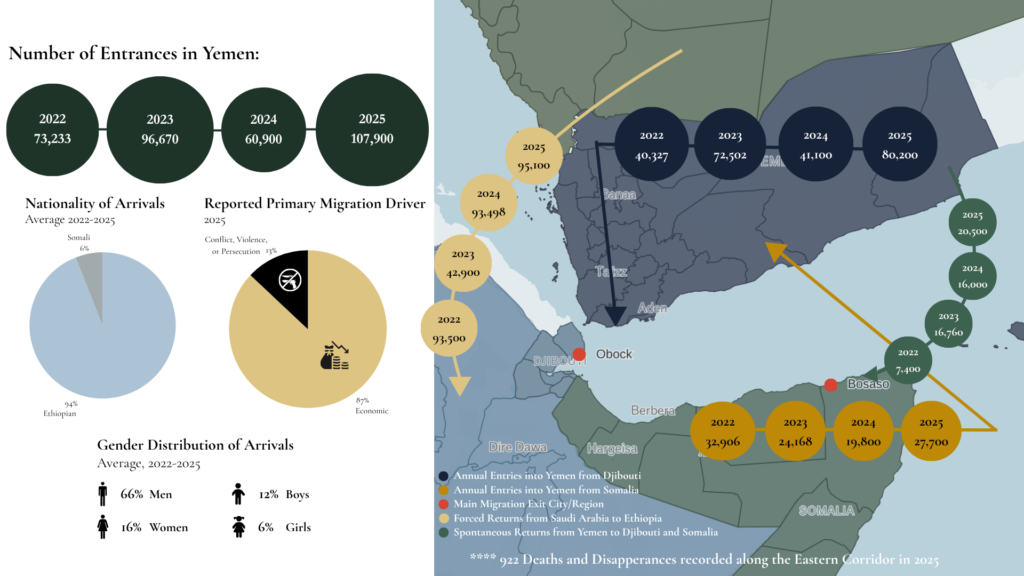
The Eastern Corridor is one of the busiest migration routes in the world. It extends from the Horn of Africa into the Arabian Peninsula, and the majority of migrants are Ethiopians travelling to GCC countries, especially Saudi Arabia, for work opportunities. Although this corridor is often understood as a labour movement channel, the dynamics of power, gender, conflict and structural dependency that shape it reveal a layered and multidirectional system of movement.
Economic Drivers, Gendered Migration and Structural Dependency
Large income disparities between sending countries such as Ethiopia and destination countries such as Saudi Arabia create strong incentives for migration in search of better employment and higher wages. Migrants working in Gulf countries can expect to earn about five times more than they would in their countries of origin.
Arrivals from the Horn of Africa into Yemen increased significantly, rising by 77% from 60,900 in 2024 to 107,900 in 2025, although data collection was halted in May, June and July of 2025. This increase reflects both improvements in reporting systems and the use of new maritime routes designed to avoid enforcement efforts in the Bab al-Mandab Strait and Lahj Governate.
This migration pattern also has a distinct gendered dimension. Between 2022 and 2025, those arriving in Yemen from the Horn of Africa through irregular pathways averaged 66% men, 16% women, 12% boys and 6% girls2. However, women account for the majority of documented migrants through formal channels along this route. This is reflected in the agreement between the Ethiopian and Saudi Arabian governments to recruit 500,000 Ethiopian women for domestic work in Saudi Arabia in 2023. This illustrates the highly gendered nature of the Eastern Corridor, as formal migration pathways target women and domestic labour, leaving many men reliant on irregular migration pathways.
Migration drivers consistently reflect the economic pull of Saudi Arabia, although conflict, violence and persecution also influence migration decisions. Survey data indicate that the proportion of migrants citing economic reasons as their primary motivation increased by 14% between 2024 and 2025, while those citing conflict, violence or persecution declined by 12% 3. However, migration decisions are more complex than such data can fully capture, and many sociopolitical factors may influence, intersect or contribute to a migrant’s decision to migrate for economic reasons. This has wider implications for policy frameworks that overlook the complexity and multi-causality of migration while only considering economic drivers.
Forced Returns, Stranded Migrants and Lack of Protection Systems
The Eastern Corridor is also characterised by bidirectional flows, as many migrants return home either from Yemen or from GCC countries. 2025 marked the highest number of forced returns since 2019. Forced returns by Saudi Arabia to Ethiopia have steadily increased from 43,900 in 2023 to 95,100 in 2025. This is consistent with Saudi Arabia’s tightening of migration controls through forced returns in 2016.
Spontaneous returns from Yemen to Djibouti and Somalia also increased by 22% between 2023 and 2025. Of those returning, 95% did not travel beyond Yemen before returning home, reflecting the country’s deteriorating humanitarian situation4. The scale of these protection challenges is further reflected in the estimated 132,000 stranded migrants in Yemen in 2025. Migrants are systematically subjected to exploitation by smugglers and traffickers along their journey. As migrants are increasingly forced to navigate conflict zones, smuggling hubs and desert crossings, they turn to new informal routes, increasing protection risks. In response, IOM assisted 6,300 migrants in voluntarily returning to Ethiopia in 2025 from Djibouti, Somalia, Lebanon and Yemen. Furthermore, 2025 was the deadliest year since data collection began in 2014, with 922 deaths and disappearances recorded. This demonstrates the emergence of a long-term migration system that has outpaced the development of adequate protection mechanisms. Migrants face heightened protection risks because of their ambiguous legal status in countries such as Yemen. Neither transiting nor formally settled, they fall outside regulatory frameworks that would otherwise provide legal protection and stability.
1.2 The Central Mediterranean Migration Route
Graphics by the MEA Institute for Strategic Studies 5
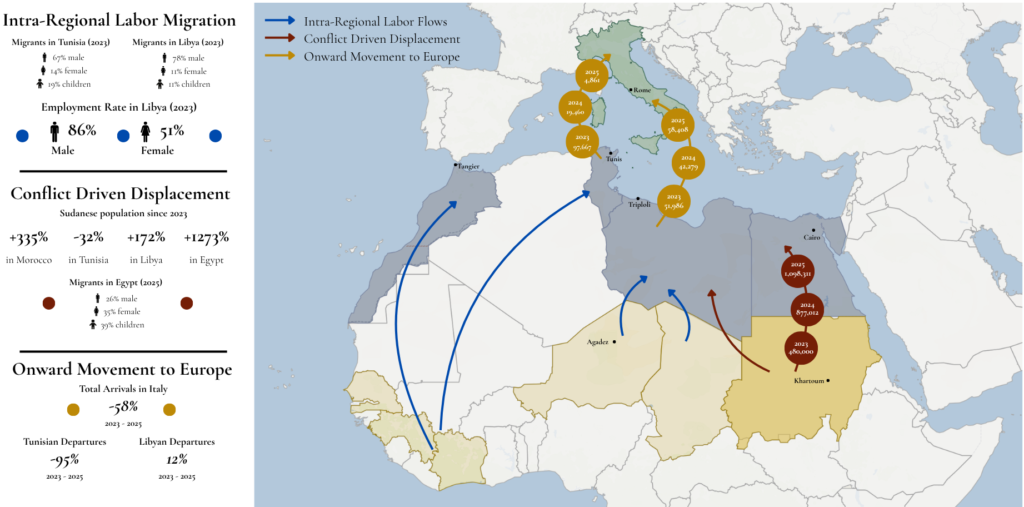
North African countries such as Morocco, Tunisia, Libya and Egypt function simultaneously as countries of origin, transit and destination within a complex intra-regional migration system. Migrants’ journeys are diverse and do not always end in Europe; onward mobility out of the region represents a subset of total continental mobility. Many moving through this corridor are in search of better employment and economic opportunities within North Africa itself. The map illustrates the complex flows of intra-regional movement and migration governance in North Africa.
Intra-Regional Labour Migration
Historically, most migrants along this route have originated from Sub-Saharan African countries such as Niger, Sudan, Guinea, Côte d’Ivoire, Chad and Senegal. Economic opportunity remains the predominant driver of movement across the region, reflected in a demographic profile that is overwhelmingly male and of working age.
Libya provides the most detailed picture for these migration flows. In 2023, migrants from three neighbouring countries, Chad, Niger and Egypt, accounted for 59% of movement into the country, falling to 48% in 2025. That same year, 79% of migrants in Libya were adult males and 11% were adult females. Over half of male migrants were employed in construction or agriculture, while domestic labour was the most common occupation for women. The overall migrant employment rate has consistently stood at around 77%, with the female rate much lower at or around 50%. These figures underscore Libya’s role as a labour destination within the regional migration system.
Tunisia shows a similar demographic profile, with adult men accounting for 69% of the migrant population at the end of 2025, consistent with labour-driven movement. Comparable employment data for Tunisia and Morocco are more limited, and a significant portion of migrants in both countries remain undocumented and outside formal registration systems, making precise measurement difficult.
Conflict-Driven Displacement
Migration patterns throughout North Africa have shifted significantly over the last three years following the outbreak of civil war in Sudan. The conflict in Sudan has displaced roughly 14 million people, approximately 4.4 million of whom have fled beyond the country’s borders, fundamentally altering the composition of migrant flows throughout the region.
The scale of this shift is visible across all four North African countries analysed. The registered Sudanese population in Egypt increased by 1,273% between March 2023 and the end of 2025, rising from 60,837 to 834,201. In Morocco, the Sudanese population grew by 335% over the same period. Libya saw an increase of 172%. Tunisia, which has seen an overall decline in its migrant population, recorded a 32% decrease in Sudanese migrants over the same period. This likely reflects the country’s declining role as both a destination and transit state.
The demographic profile of Sudanese displacement in Egypt reflects both the nature of conflict-driven flight and the policies governing who is permitted to cross. At the onset of the conflict, Egypt allowed women and children fleeing Sudan to enter while restricting the movement of men – a policy distinction that shaped the registered population. The resulting composition, 74.5% women and children, stands in contrast to the predominantly male labour migration flows that characterise the broader region, illustrating how border governance actively determines who is counted and where.
While labour migration and conflict-driven displacement increasingly define mobility within North Africa, movement towards Europe remains an important, though declining, component of the regional migration system.
Arrivals to Europe
Over the last three years, the number of migrants arriving in Italy via North African routes has fallen sharply. Total arrivals to Italy decreased by 58% between 2023 and 2025, dropping from 157,652 to 66,316. This decline has been driven largely by heightened border enforcement by North African authorities at sea, in close collaboration with European partners.
Tunisia, once the primary departure point for migrants crossing to Europe via Italy, saw the most dramatic reduction. Tunisian departures fell by 95% between 2023 and 2025, reflecting the significant tightening of border controls along the Central Mediterranean route. Libya, by contrast, saw departures increase by 12% over the same period, suggesting that as the Tunisian route has shrunk, some onward movement has shifted to Libya.
Morocco and Tunisia, long regarded as primarily countries of origin and transit, have become destinations in their own right. As the prospect of reaching Europe has diminished, many migrants have opted to remain, drawn by relative stability and economic opportunity within North Africa itself. The sharp decline in departures across the region is inseparable from Europe’s broader strategy of externalising its border enforcement.
1.3 The Eastern Mediterranean Migration Route
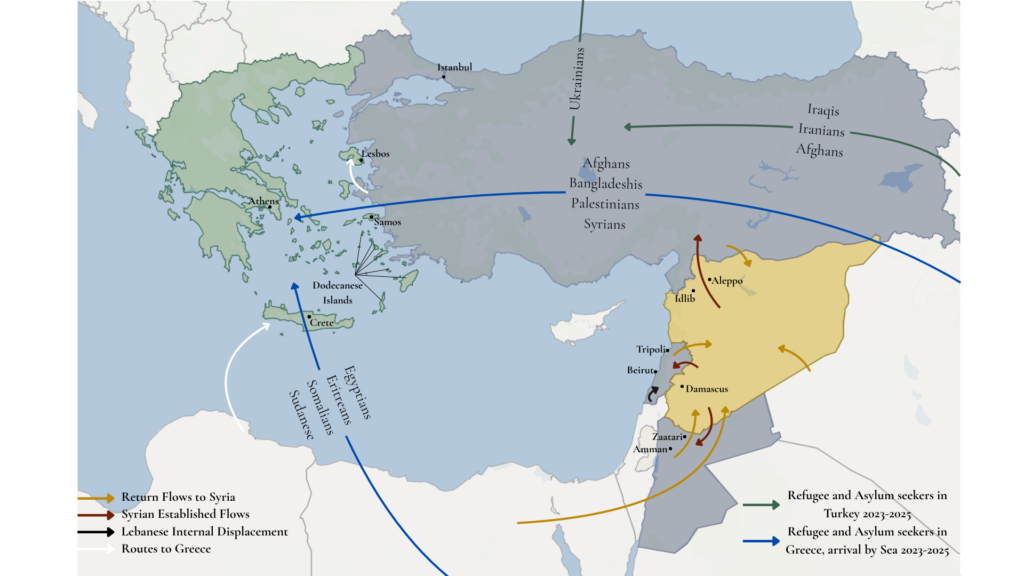
Graphics by the MEA Institute for Strategic Studies 67

The Eastern Mediterranean remains one of the world’s principal migration corridors, but the geography of movement has become increasingly layered. Rather than functioning solely as a pathway into Europe, the corridor encompasses overlapping systems of protracted refugee hosting, onward transit, internal displacement and Syrian return migration. These overlapping forms of mobility reflect a regional migration system shaped simultaneously by conflict, economic opportunity, politics and evolving border governance. While the corridor is often viewed through the lens of migration into Europe or conflict-driven displacement, the evidence presented here points to a more complex regional system characterised by economic opportunities, political shifts and evolving border governance.
Mobility in Changing Routes 88
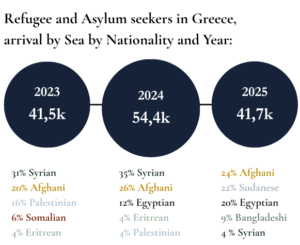
The Eastern Mediterranean was the busiest route into Europe in 2024 and the second busiest in 2025. Migration through this corridor has long been centred on routes through Türkiye.
However, changes in both routes and demographic profiles suggest that mobility in the region is increasingly adaptive rather than fixed. Migration into Greece has remained relatively consistent, averaging approximately 45,800 arrivals between 2023 and 20259. Crossings have traditionally followed eastern routes from Türkiye to islands like Lesbos, Samos and the Dodecanese. However, the route from Libya to Crete has grown significantly since 2024, accounting for 47% of sea arrivals in 2025. Changes in entry points have been accompanied by shifting arrival demographics. In 2023, Syrians, Afghans and Palestinians represented the largest groups arriving by sea in Greece, with Palestinian arrivals increasing following the outbreak of the genocide in Gaza in October 2023, reaching more than 6,700 crossings that year. By 2025, however, arrivals increasingly included Sudanese, Egyptian and Bangladeshi nationals, reflecting the growing prominence of the Libya-Crete route.
Over 1000% increase in sea arrivals to Greece via Crete from 2023 to 2025
These changes reflect the limitations of EU externalisation policies under evolving geopolitical dynamics among Libya, Türkiye and Greece, and shifting political control of the Libyan coast10. While crossings through the eastern Aegean remain significant, the rapid growth of arrivals to Crete demonstrates how migration routes, smugglers and the populations using them adapt to changing political, security and enforcement environments rather than disappearing altogether.
Long-Term Displacement and Hosting Patterns11
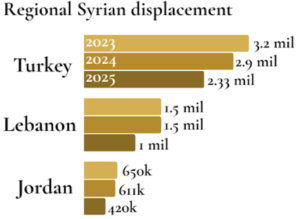
The Eastern Mediterranean also illustrates the enduring impact of the Syrian conflict on regional migration systems. More than a decade after the outbreak of civil war in 2011, neighbouring countries continue to function as major host states for displaced Syrians. Jordan, Lebanon and Türkiye remain central components of regional hosting frameworks, while refugee infrastructure has become a permanent feature of the migration landscape. Established in 2012 as an emergency response, the Zaatari refugee camp in northern Jordan has evolved into one of the world’s largest and most enduring refugee settlements. The camp began as a collection of semi-urban tents and makeshift shelters, hosting 180,000 people at its peak directly following the onset of the war.
For much of the past decade, it hosted approximately 80,000 people, although its population has recently declined to around 50,000, the lowest level since its establishment. Although the camp’s population has declined substantially, its continued operation more than a decade after its creation underscores the enduring nature of displacement in the region, demonstrating how temporary humanitarian responses often evolve into long-term governance structures.
At the same time, active displacement continues within the Levant. Ongoing insecurity in Syria and conflict along the Syria-Lebanon border continue to generate displacement and movement throughout the region. After the onset of hostilities in Gaza in October 2023, about 76,000 people were internally displaced, mainly from southern Lebanon. The 2024 war between Israel and Hezbollah displaced nearly 900,000 people within Lebanon and 550,000 across the border into Syria. These flows differ from the established transit routes visible elsewhere on the map, as they are primarily driven by immediate security concerns rather than long-term migration networks. These developments demonstrate that the Eastern Mediterranean simultaneously experiences protracted refugee hosting and new episodes of conflict-induced displacement, reinforcing the layered nature of migration in the region.
As one of the world’s largest host countries, Türkiye hosts approximately 2.5 million refugees, the second-largest refugee population globally. The majority, 2.3 million, are Syrian nationals classified under Türkiye’s Temporary Protection regime, which grants them the legal right to remain and access basic services. Despite being granted legal protection, many Syrians continue to face restrictions on movement, discrimination, financial hardship linked to employment and housing insecurity and difficulties obtaining or renewing legal documentation. Refugees and asylum seekers registered under international protection receive more limited rights and protections than Syrians under Temporary Protection. As holders of only conditional refugee status, they face heightened vulnerability under intensified deportation policies despite possessing legal status.
In 2024, the Turkish government deported 141,000 individuals, with many migrants reportedly forced to sign voluntary return forms. Türkiye illustrates how long-term displacement does not necessarily lead to durable protection. While refugee communities have become deeply embedded within the country’s migration landscape, increasingly restrictive protection policies and intensified deportation efforts have left many migrants in a prolonged state of legal and social uncertainty.
Syrian Returns without a Framework 1213
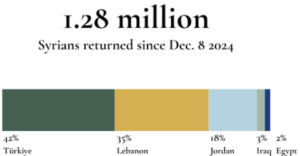
A significant development in the Eastern Mediterranean migration system is the emergence of large-scale return migration into Syria following the collapse of the Assad government in December 2024. Since then, approximately 1.3 million Syrians have returned from neighbouring countries, including more than 500,000 from Lebanon, 175,000 from Jordan and 600,000 from Türkiye.
These returns represent the most significant shift in regional mobility patterns since the outbreak of the Syrian conflict, marking a transition from a system defined almost exclusively by displacement to one increasingly characterised by return migration.
However, return does not necessarily indicate recovery. Many are returning to communities where housing, infrastructure, public services and livelihoods remain severely disrupted. Additionally, approximately 7 million people remain internally displaced within Syria. The coexistence of large-scale returns and one of the world’s largest internally displaced populations highlights the uncertainty surrounding post-conflict mobility. While many Syrians are choosing to return, they are doing so in the absence of a comprehensive framework governing reintegration, property rights, housing or long-term recovery. Large-scale returns following the fall of the Assad government demonstrate that mobility in the Eastern Mediterranean is no longer defined exclusively by displacement. Yet continued internal displacement and the absence of durable reintegration mechanisms suggest that return represents another stage within an ongoing migration system rather than its conclusion.
Taken together, the Eastern Mediterranean corridor illustrates a migration system in transition. Established routes through Türkiye and the Aegean remain active. Regional hosting structures continue to support displaced populations, and large-scale returns are reshaping mobility across the Levant.
Rather than signalling a resolution of migration pressures, the period between 2023 and 2025 demonstrates how regional mobility has continued to evolve while the policy frameworks intended to govern it have struggled to adapt. Migrants will continue to adapt their routes in response to changing political and regulatory environments. As deportations increase and externalisation policies are strengthened, those facing conflict and economic hardship continue to navigate dehumanising systems, adapting their mobility strategies and livelihoods as temporary arrangements increasingly become long-term realities.
1.4 Transit Migration towards Europe
Border Externalisation and Smuggling Networks in the Central and Eastern Mediterranean
Transit migration towards Europe has become increasingly shaped by shifting enforcement regimes, geopolitical instability and the fragmentation of migration governance across the MENA region. Rather than following fixed trajectories, migration corridors evolve in response to changing political, economic and security dynamics, reflecting the interaction between border control policies, local actors and migrants’ adaptive strategies. In this context, routes through North Africa and the Mediterranean are not static pathways but dynamic systems continuously reconfigured by both state and non-state actors.
Border Externalisation and Migration Control
EU border enforcement has undergone a significant transformation over the past decade, marked by the expansion of externalisation policies and the growing operational role of agencies such as Frontex. Rather than focusing exclusively on territorial borders, the EU increasingly projects migration control beyond its frontiers through cooperation with third countries, financial assistance and the deployment of surveillance and enforcement capacities. This strategy aims to prevent migrants from reaching EU jurisdiction altogether, effectively creating a “pre-border buffer zone.”
While recent data suggests that irregular crossings fell by approximately 26% in 2025 and by over 30% in early 2025, the effectiveness of these measures in reducing migration remains contested. Evidence indicates that such measures do not eliminate migration pressures but rather redirect them geographically. For instance, while overall crossings declined, new corridors such as routes from eastern Libya to Crete have emerged, illustrating the adaptability of migration pathways.
Scholarly literature consistently finds that externalisation policies fail to address root causes and instead produce unintended consequences, including increased reliance on riskier routes and heightened mortality. In this sense, border enforcement does not reduce migration so much as reconfigure its geography, often shifting risks onto migrants while outsourcing control to third countries with limited human rights safeguards.
Smuggling Networks and Informal Migration Systems
Migration across the MENA region remains deeply embedded within complex smuggling networks that function as adaptive, profit-driven systems. These networks are not eradicated by stricter border enforcement; rather, they evolve in response to it. As enforcement intensifies, smugglers adjust routes, methods and partnerships, ensuring the continuation of migration flows despite increasing constraints.
Empirical evidence demonstrates a “cat-and-mouse” dynamic between European policies and smuggling actors, whereby enforcement measures displace rather than dismantle illicit networks. For example, agreements such as the Italy-Libya Memorandum and related arrangements initially reduced crossings but simultaneously incentivised the reorganisation of smuggling routes, including the expansion of eastern Libyan corridors and alternative Mediterranean pathways. This adaptability is sustained by persistent demand: as long as legal migration opportunities remain limited, smuggling services retain significant economic value.
Moreover, externalisation policies have, in some cases, reshaped rather than weakened these networks. In Libya, arrangements with local actors have blurred the line between state and non-state authority, transforming former smugglers into participants within migration control systems, including coastguards and detention administrators. This has contributed to the emergence of hybrid systems where smuggling, trafficking and formal governance intersect.
Ultimately, enforcement-driven policies tend to increase the cost, danger and complexity of migration without eliminating the underlying systems that sustain it, thereby reinforcing the centrality of smuggling networks in shaping migration flows.
Taken together, these dynamics demonstrate that migration corridors are not merely geographic routes but manifestations of a migration system in constant structural transition. As border enforcement intensifies in one area, migration flows adapt through the emergence of new pathways, actors and methods, revealing the resilience and flexibility of both migrants and smuggling networks. The continued diversification of routes across the Central and Eastern Mediterranean illustrates that migration pressures are not eliminated by restrictive policies but are instead redistributed across space and actors. In this sense, migration corridors function as living systems that evolve according to the structural realities on the ground, including conflict, economic inequality, governance gaps, labour demand and environmental pressures. As long as these underlying drivers remain unaddressed, demand for migration will persist, and people will continue to move despite increasing risks and barriers. Consequently, enforcement-centred approaches may alter the geography of migration but are unlikely to fundamentally reduce mobility in the long term.
Conclusion
This policy report demonstrates that the broader Mediterranean region, spanning North Africa, the Horn of Africa and the Middle East, can no longer be understood primarily as a transit zone for migrants and refugees travelling to Europe or the Gulf. Instead, it has evolved into a complex migration system characterised by multidirectional mobility, labour-market integration and settlement patterns that increasingly blur the distinction between temporary and permanent residence.
The findings demonstrate that the Eastern Corridor functions as a bidirectional migration system, characterised by large-scale labour migration towards the Gulf and growing numbers of forced and voluntary returns. Many migrants become stranded in Yemen, where severe humanitarian conditions intersect with significant protection gaps. In the Central Mediterranean, Libya, Tunisia and Morocco increasingly function as labour destinations in their own right, hosting both economic migrants and people displaced by conflict in Sudan. In the Eastern Mediterranean, what were initially conceived as temporary refugee-hosting arrangements have evolved into durable governance structures that manage long-term displacement.
Taken together, these three corridors demonstrate that the migration architecture that has emerged across the broader Mediterranean is not temporary or exceptional but a durable feature of the regional landscape. Border externalisation efforts, for example, have increased the risks associated with migration rather than tackling the root causes or encouraging legal pathways. For example, externalisation does not weaken smuggling networks, which, on the contrary, adapt to changes by diversifying routes or relying on local proxies. Addressing this contradiction requires recognising the MENA region as a complex migration system with distinct labour-market dynamics and long-term protection needs, and tailoring policy responses to the realities of each migration corridor.
Recommendations
1.1 The Eastern Corridor: The Horn of Africa to the Gulf:
The Eastern Corridor’s migration system is shaped as much by who is permitted to move formally as by economic demand itself. Building on the findings presented in this report, the following recommendations aim to close the gap in legal labour pathways and strengthen protections for informal migrants navigating the dangerous route.
Expand legal labour migration pathways to include economic opportunities for men. Formal migration channels between the Horn of Africa and the Gulf remain heavily gendered, leaving men with little choice but to travel via irregular routes. Regional governments should work to extend formal labour migration agreements to cover male-dominated sectors, giving men the same access to safe, regulated pathways currently offered to women. Excluding men from formal channels does not reduce their movement; it pushes them towards routes with greater exposure to exploitation, trafficking and death.
Strengthen protection mechanisms and expand IOM’s capacity to assist stranded and returning migrants. With an estimated 132,000 migrants stranded in Yemen, and hundreds of deaths or disappearances recorded in 2025 alone, the corridor’s protection gaps have become a humanitarian emergency in their own right. IOM should consider increasing its capacity to support voluntary returns from Yemen, Djibouti, Somalia and Lebanon. Host governments and international partners should also work to extend legal protections to migrants stranded in transit, who currently fall outside existing frameworks because they are neither entering formally nor able to move onward and are therefore stuck in limbo.
1.2 The Central Mediterranean Migration Route:
The Central Mediterranean data show a region whose migration governance has not kept pace with its transformation from a transit corridor into a durable system of labour migration and, increasingly, permanent settlement. The following recommendations aim to strengthen labour protections and improve the region’s capacity to absorb conflict-driven displacement.
Formalise labour migration channels and strengthen worker protections. The high concentration of migrants in Libya’s informal construction, agricultural and domestic labour sectors reflects a structural reliance on undocumented and unregulated work. Regional governments, coordinated through the African Union and relevant economic communities, should work towards formal labour migration agreements that give migrants legal employment status, back their wages with enforceable protections, and give host economies greater visibility of the workforce on which they depend. Similar registration and data-collection systems should be extended into Tunisia and Morocco, where undocumented labour currently makes reliable measurement difficult, so governments and international partners can design policies around accurate figures rather than estimates.
Scale up international support for countries absorbing Sudanese displacement. The scale of displacement from Sudan’s civil war has reshaped migrant populations across Egypt, Libya, Tunisia and Morocco, with registered Sudanese populations increasing several-fold in some cases since 2023. Emergency humanitarian assistance has been essential to meeting the immediate needs of the displaced Sudanese population. However, with the conflict now in its fourth year, its protracted nature suggests that it is time to move towards longer-term support. UNHCR and international donors should consider gradually shifting their focus towards service delivery, local integration and municipal capacity building in host communities, accompanied by stronger coordination with national and municipal authorities to ensure host communities are equipped to absorb the population over the long term.
1.3 The Eastern Mediterranean Migration Route
The Eastern Mediterranean is best understood as a system of long-term displacement, differentiated legal status and unresolved return, rather than a corridor defined solely by movement into Europe. The following recommendations aim to close the gap between the region’s protracted realities and the protection frameworks meant to govern them.
Strengthen legal protection frameworks to match the reality of protracted displacement. More than a decade into the Syrian conflict, Jordan and Lebanon continue to function as long-term host states, with camps like Zaatari now a permanent feature of the regional landscape rather than an emergency measure. At the same time, refugees and asylum seekers registered under international protection, as distinct from those under Türkiye’s Temporary Protection system, have weaker legal standing and face heightened exposure to deportation. Host governments, UNHCR and international donors should work towards legal frameworks that reflect the durability of these displacement situations, extending greater legal certainty to those currently living under conditional or temporary status, and ensuring protection standards are extended to migrants regardless of their regulatory category.
Establish a coordinated framework for Syrian reintegration. The return of over 1.3 million Syrians since the fall of the Assad government marks a major shift in regional mobility, but this movement is occurring without a corresponding framework to govern reintegration, property restitution or access to housing and services. With approximately seven million people still internally displaced within Syria, return alone does not resolve the underlying displacement crisis. The transitional government, together with UNHCR and international donors, should prioritise the development of a coordinated reintegration framework that addresses property rights, rebuilds essential services in areas of return, and supports durable solutions for both returnees and those still internally displaced.
1.4 Transit Migration towards Europe
The findings from the Central and Eastern Mediterranean route show that the EU’s border externalisation measures redirect illegal migration rather than address it, increasing the risks related to crossings for migrants while overlooking the causes. The following recommendations aim to shift the focus of migration governance away from externalisation and highlight the importance of frameworks that ensure migrants’ safety.
Prioritise the creation of safe and legal pathways.
The EU and regional authorities should focus on expanding legal channels and redirect the funding, for example, to ensure access to humanitarian visas and legal mobility schemes for seasonal and non-seasonal jobs. Lowering reliance on irregular cross-border movements would reduce migrants’ exposure to smuggling networks and mortality risks.
Establish an independent human rights oversight mechanism.
The EU, North African, and Eastern Mediterranean countries should set up monitoring and evaluation mechanisms to ensure local actors’ accountability and the protection of human rights – including the treatment of migrants in detention centres and the use of force. Funding should be suspended when migrants’ rights are violated. This would prevent outsourcing of border management from being the outsourcing of responsibility for human rights abuses.
- Compiled using IOM data from 2022, 2023, 2024, 2025 ↩︎
- Compiled using IOM data from 2022, 2023, 2024, 2025 ↩︎
- Compiled using IOM data from 2022, 2023, 2024, 2025 ↩︎
- Compiled using IOM data from 2022, 2023, 2024, 2025 ↩︎
- Migrants in Libya gender breakdown; Tunisia gender breakdown; Employment rate in Libya 2023, Sudanese population in Egypt; Libya 25; Libya 23; Tunisia 25; Tunisia 23; Morocco 25; Morocco 23; Egypt gender breakdown, Italy arrivals 25; Italy arrivals 23; Tunisia / Libya Departures 25; Tunisia / Libya Departures 23 Sudan into Egypt in 2023, 2024, 2025 Blue arrows from yearly average of: Libya in 2023, 2024, 2025; Tunisia 2023, 2024, 2025; and Morocco in 2023, 2024, 2025 ↩︎
- Compiled using: Greece Arrivals UNHCR 2023, Greece Arrivals UNHCR 2024, Greece Arrivals UNHCR 2025, IOM MPM Türkiye Overview 2023, IOM MPM Türkiye Overview 2024, UNHCR Syrian Return 2025, Lebanon mobility ↩︎
- Türkiye – Syria Earthquakes, Erdogan wins elections, Escalation in southern Lebanon, Lebanon ceasefire, Syrian returns, Transitional government institutions established ↩︎
- Compiled using data from UNHCR in 2023, 2024, and 2025 ↩︎
- Calculated from UNHCR Data 2023, 2024, 2025 ↩︎
- Compiled using: Greece Arrivals UNHCR 2023, Greece Arrivals UNHCR 2024, Greece Arrivals UNHCR 2025 ↩︎
- Turkish data from Turkish government sources in 2023, 2024, and 2025; Lebanon data from UNHCR in 2023, 2024, and 2025; Jordan data from UNHCR in 2023, 2024, and 2025 ↩︎
- UNHCR Syrian Return Overview 2025 ↩︎
- UNHCR Syria IDPs & IDP Returnees Overview 2025 ↩︎
The MEA Institute for Strategic Studies does not take institutional positions on public policy issues; the views expressed in this publication are those of the author(s) and do not necessarily reflect the views of the Institute, its staff, or its board.