
Ceuta and the Business Nobody Talks About: What Europe’s Border Crisis Really Exposes
Late last month, an estimated 50,000 to 60,000 people, most of them Moroccan nationals, crossed by land and sea into Ceuta, Spain’s North African enclave, in one of the largest single-border movements ever recorded at an EU external frontier.
Within days, the story had settled into a familiar shape. Spanish and European commentary largely attributed the surge to Morocco deliberately loosening its border controls, a repeat, many said, of the 2021 crisis, when Rabat was widely seen as retaliating against Madrid over its handling of a Polisario Front leader. That framing is comforting because it is simple: it puts the blame on one actor’s decision and leaves the rest of the system untouched. It is also incomplete.
A less-discussed factor in the run-up to the crisis is legal rather than diplomatic. On 29 June 2026, Spain’s Supreme Court ruled that migrants intercepted while swimming towards Ceuta or Melilla, rather than crossing the physical border fences, cannot be subject to the country’s expedited “hot return” procedure. They must instead go through ordinary immigration processing, including identification, legal assistance and access to asylum claims. The ruling did not grant anyone an automatic right to stay, but it changed the calculation migrants and smugglers make: a slower, more contestable removal process is, in practical terms, a narrower one. News of a legal shift like this travels fast through migrant networks and the criminal groups that profit from moving people, and the timing, right before the summer surge, is difficult to read as coincidence.
This is where the conversation about Ceuta, and about the Mediterranean more broadly, tends to go quiet. It is far easier to discuss a diplomatic spat than to look closely at the infrastructure that actually moves people across these borders, much of it built and run by organised smuggling networks that have had two decades to professionalise. In March 2026, Spanish police dismantled a smuggling operation in Ceuta built around a three-level tunnel running under an industrial warehouse into Morocco, complete with a rail and pulley system for moving cargo, seizing over 17 tonnes of hashish and arresting 27 people, including the network’s alleged leaders. Europol has separately estimated that more than 90% of migrants reaching the EU now rely on some form of facilitation service, most of it provided by criminal groups, and has dismantled smuggling operations moving well over a thousand people at a time between just two European countries. These are not peripheral details. They are the actual mechanics of “irregular migration,” and they thrive precisely in the grey zones that current border policy keeps producing.
That policy is externalisation: the EU’s now-decades-old habit of transferring migration control, interception, surveillance, and increasingly asylum management, to neighbouring states like Morocco, Tunisia, Libya and Mauritania, in exchange for funding and political goodwill. It has never been a neutral technical arrangement. It hands Europe’s southern neighbours real leverage over European policy, since a state that is asked to police thousands of kilometres of coastline on someone else’s behalf can also choose to police it a little less. It has also, less visibly, meant that the space between where European law applies and where a partner state’s law applies is exactly the space where accountability tends to disappear, for smugglers, for the officials who look away, and occasionally for states themselves. When something goes wrong in that space, whether a tunnel, a death at sea, or a diplomatic dispute dressed up as a security crisis, no single authority is straightforwardly responsible, and that is not an accident of the system. It is close to the system’s design.
None of this means Morocco “opened the gates,” nor does it mean Spain’s courts were wrong to extend legal protections to people intercepted at sea; both explanations, on their own, are too tidy for what is a genuinely multi-causal problem. But treating Ceuta as a one-off diplomatic flare-up, rather than a predictable output of an externalised, under-governed border system, guarantees that the same crisis recurs, with the same actors, largely unaccountable, profiting in the gaps. If governments in the region are serious about the Mediterranean’s next migration landscape rather than just its next crisis, that landscape has to include the smuggling economy as a structural feature to be governed, not a scandal to be discovered anew each summer.
The MEA Institute for Strategic Studies does not take institutional positions on public policy issues; the views expressed in this publication are those of the author(s) and do not necessarily reflect the views of the Institute, its staff, or its board.
The Indigenisation of Drone Warfare in Africa
The Making of Morocco’s Gen Z Protest
Indigenisation of Drone Warfare in Africa
From Airframes to Algorithms: The shift to software-centric control
The African continent is witnessing a rapid expansion of the drone environment implicating a wide and complex array of local players and proxy actors. Over the past two decades, at least 31 African countries have acquired thousands of individual unmanned units.1 The use of Unmanned Aerial Vehicles (UAVs) is not exclusively linked to governmental forces as non-state actors in more than nine different countries, in multiple regions such as Sahel, Lake Chad Bassin and horn of Africa, have acquired and used drones altering tactics for governments and insurgents alike. Primarily, most African non-state actors (NSAs) used drones as passive tools for Intelligence, Surveillance, and Reconnaissance (ISR) and videography purposes. This experimental phase of early adoption and iteration allowed NSA groups, such as militias, armed actors, terror groups, to shift tactical capabilities.2 These groups depend on cheap hobbyist models and locally produced drones to project power beyond their capabilities, imposing an illusion of a closed gap between them and the sovereign military. Traditionally, state forces monopolised airspace control, however the proliferation of drones has meant the emergence of a new era, where state sovereignty is highly contested. The adaptation of COTS drones to drop explosives on military positions has revolutionised insurgent tactics, such as the use of drones as kamikaze suicide weapons. Terrorist groups such as al-Shabaab in Somalia and Jamaat Nusrat al-Islam wal-Muslimin in Burkina Faso and Mali have turned3 adapted drones into airborne improvised explosive devices by mounting bombs to them. Drones also serve as a psychological tool to send a message of intimidation and project power for propaganda purposes.4
Several factors can explain the adoption of drone proliferation such as cost and accessibility: the price and availability of drones and its components mean that even smaller groups can utilise them.5 Furthermore, major drone producers such as Türkiye and China use UAVs as a foreign policy tool to enhance their influence in the continent.6 This leads to an important aspect in drone warfare. Such warfare is shaped more by the software defined systems than the airframes itself. In other words, the main point is now: who holds the keys or the codes rather than who owns drones. The centre of gravity of the equation has therefore shifted towards data flows and who can ensure operational continuity despite sanctions and vendor policy changes. Drone warfare’s mission effectiveness is now related to the software loop of “the sensor-to-shooter” which allows reliable feeds and quick coordination of imagery into fire and resilient links. Furthermore, a key point of drone warfare is the idea of dependency and coercive leverage, especially in software supply chains. A state or a militia can own the airframe’s however, it would remain highly dependent on external factors such as firmware updates, the database for maps and the cloud linked device services.
Theatres and Trends
Across multiple African conflict theatres, UAVs have shifted from niche enablers to standard components of both state and non-state force structures, driven by cost compression in commercial dual-use supply chains that allows even fragmented armed groups to field rudimentary Intelligence, Surveillance, and Reconnaissance (ISR) and strike capabilities.7
At the same time, a clear indigenisation trend is visible as a growing number of African states assemble or manufacture military UAVs domestically and local technical networks adapt commercial quadcopters for reconnaissance, loitering munitions and information operations, with access pathways ranging from formal state procurement and licensed production to battlefield capture, foreign sponsorship and illicit acquisition among non-state actors. Operationally, drones extend strike depth, enable infrastructure interdiction, sustain siege dynamics and generate real-time propaganda, effects that are especially decisive in territorially fragmented wars and borderland environments where conventional airpower is limited or absent.8
Sudan–Ethiopia Border Dynamics: The war in Sudan has evolved into one of the most drone-intensive conflicts on the African continent, with unmanned aerial systems (UASs) embedded into routine operational planning by both the Sudanese Armed Forces (SAF) and the Rapid Support Forces (RSF). Since 2023, the SAF has incorporated Iranian-supplied systems such as the Mohajer-6 and Ababil series, reportedly accompanied by technical training and maintenance support.9 These platforms have provided ISR depth and strike capability against RSF urban positions and logistics hubs. In parallel, the RSF has deployed loitering munitions and modified commercial drones, widely assessed to be enabled through transnational procurement channels linked to Gulf networks.10 The diffusion pattern reflects the broader African trend in which external suppliers leverage drones as instruments of geopolitical access and influence.
The Ethiopia–Sudan border has become strategically relevant in this ecosystem. Reporting indicates RSF elements have utilised cross-border rear areas for training and logistical reconstitution, including drone operations infrastructure in western Ethiopia. This reflects a structural feature of drone warfare in fragmented conflicts: borderlands function less as static territorial disputes and more as force-generation depth for remote strike capacity. Concurrently, Ethiopia’s investment in domestic UAV production following its own internal conflicts signals movement toward technological indigenisation.11 The drivers are operational necessity, reduced acquisition costs, and the strategic appeal of deniable or scalable airpower. Access is therefore tiered: state actors obtain systems through formal defense partnerships; paramilitary actors exploit covert logistics and external sponsorship; and neighbouring states leverage domestic production to consolidate autonomy. The Sudan–Ethiopia theatre illustrates how drone proliferation reinforces proxy competition while accelerating local doctrinal absorption.
Democratic Republic of the Congo as a Mixed Actor Ecosystem: In eastern Democratic Republic of Congo the (DRC), drone proliferation reflects a mixed-actor conflict system in which state forces, foreign-backed insurgents, local militias, and external security partners operate concurrently. The Armed Forces of the DRC (FARDC) have acquired military UAVs through bilateral security cooperation arrangements, integrating them into reconnaissance and artillery-spotting roles.12 These systems are primarily used to compensate for weak airpower infrastructure and the challenges of operating in forested and mountainous terrain. The principal operational driver is persistent in ISR in an environment characterised by fluid militia mobility and porous borders.
Non-state armed groups, including M23 and various Mai-Mai formations, access drone capability through indirect state sponsorship, battlefield capture, or commercial procurement. Commercial quadcopters adapted for reconnaissance or rudimentary munition delivery have become particularly significant because they are affordable, concealable, and difficult to regulate.13 While their kinetic impact remains limited relative to Sudan, their intelligence value is disproportionate, compressing the sensor-to-shooter cycle and enhancing ambush planning. External actors operating in theatre, including regional forces, further normalise UAV use, contributing to doctrinal diffusion across armed groups.
The drivers of drone proliferation in the DRC include low acquisition thresholds, the need to monitor mining corridors and transport routes, and the symbolic value of technological parity among armed factions. Unlike Ethiopia, the DRC is not yet a producer state; however, it exemplifies indigenisation at the adaptation stage, where tactical knowledge and modification skills circulate horizontally among conflict actors. Access pathways therefore span formal state procurement, proxy supply networks, and civilian market conversion. The DRC case demonstrates that indigenisation is not solely industrial but also doctrinal: the embedding of UAV tactics into local warfare practices even in the absence of domestic manufacturing capacity.
Sahel Theatres: In the Sahel, drone warfare has turned into a competition between state Medium Altitude Long Endurance MALE armed drones and non-state actors acquiring rapid commercial drones and adapting them into ISR and strikes. In Mali and Burkina Faso, officials have publicly announced the acquisition of armed Turkish drones Bayraktar TB2. The states use these drones for surveillance and precision strikes against jihadist camps. However, the usage of these drones has been a contentious topic due to reports emerging on multiple occasions of civilian casualties. Drone use allows actors to amplify strike capacity, but it does not ensure precision. Jihadist groups have opted for a sustained operational drone warfare across borders through kamikaze style attacks and ISR guided assaults.14 In May 2025, the Islamic State-Sahel carried out an attack on military positions in Eknewan, Niger, using one-way attack drones killing 64 soldiers.15 These actors use COTS drones as an improvised tool for grenade drops and explosive attacks. According to ACLED, at least 69 drone strikes by an al-Qaeda affiliate in Burkina Faso and Mali have been recorded since 2023.16
Libya: The Libyan conflict is a clear example of how drone proliferation can transform a civil war into a proxy war via air campaigns. Libya’s layered ecosystem served as a fertile field for drone war as the presence of external actors and local armed coalitions and contractors allowed a chain of supply for drones through logistics networks. The offensive on Tripoli in April 2019 marked the shift to armed drones as a central part of the war. The armed drones were used by both belligerents to strike, cut supply chains and even put pressure on air bases. The Government of National Accord (GNA) benefited from the support of the Turkish government through its Turkish Bayraktars TB2s while Haftar’s regime used Chinese origin systems reportedly linked to an Emirati backing as it is one of the closest allies.17 The usage of drones in the Libyan theatre widened the conflict’s strike radius and allowed for less accountability as attribution of strikes became either highly contested or intermediated through third party operators and foreign supplied systems. This highlights the low political cost of remote strikes as belligerents refuse to take responsibility for them as they were done through intermediaries.
Inside the Stack
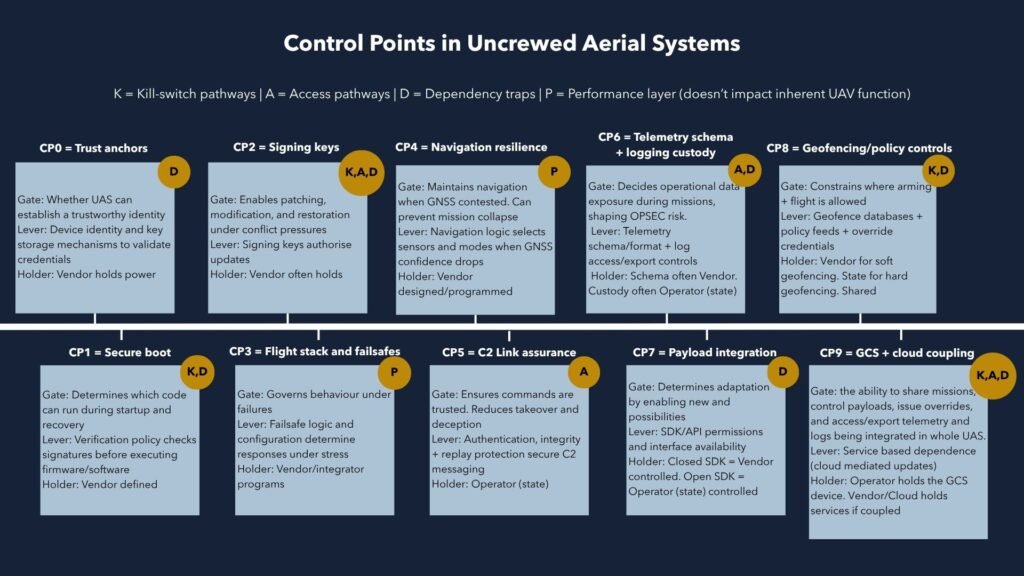
Control Authority Layers (CLA) Model
This model conceptualises how layers of CPs build on each other to shape UAS functions. Lower layers (Control Point 0) determine what code runs and who can control it. These build up to and gate the higher layers (Control Point 9) which eventually determine exactly what and how the UAS operates on the battlefield. This is crucial in understanding the drone indigenisation possibilities in any given geographical location. Each part of the UAS requires a digital or physical infrastructure whose composition can be determined or obstructed by its place of origin.
The principal salient states contributing to drone indigenisation in Africa are Nigeria, Egypt, Morocco, South Africa and Ethiopia. The CLA model shows that indigenisation can succeed or stall depending on who holds control authority over each stage of the UAS. The GCS is the key foundational control point of indigenisation because it is where combat use becomes repeatable. The GCS handles mission planning, command authority, payload tasking, credential handling, and telemetry logging. Looking internationally, Baykar’s TB2 emphasises the GCS as a core part of the overall system.18 For national military level missions, GCSs larger than mere remote controls or computers, such as mobile or fixed headquarters, are normally necessary.19 In these cases, native GCSs need to be developed by African militaries to ensure missions have the potential to become fully indigenous. Standards such as STANAG 4586 centre the control system interface as the key integration layer across UASs.20 Recent satellite imagery in RSF-controlled regions in Sudan has shown the importance of GCSs, with multiple reportedly being quickly built. The speed of their construction also shows the possibility for this aspect of the UAS to be indigenised quickly with some up-front investment.21
African indigenisation signals are strongest when states institutionalise UAS-level capability. Nigeria’s Air Force (NAF) indigenously produced the Tsaigumi, signalling a large step beyond step only building airframes. The NAF reportedly have plans to develop the Ichoku, which promises to be another indigenous Nigerian UAV.22 The Seeker 400 UAS made in South Africa provides a domestic benchmark, illustrating what system indigenisation can look like when an industrial base exists.23 Without that, there they may have to be higher levels of international cooperation to develop domestic systems, as Egypt and Morocco are involved in, which can compromise potential to control fully indigenous systems.24 However, as seen with Egypt’s latest Hamza-3 drone, some development processes may initially include international involvement (China, in this case), but plan to phase it out and localise production in the future.25
For conflict use, “encryption” should be treated as link assurance. MAVLink 2’s message signing allows a system to verify that messages originate from a trusted source, and ArduPilot is explicit that signing “does not encrypt the data,” only controls whether the autopilot responds to commands.26 This distinction matters for indigenisation because sovereignty depends on who controls credentials, telemetry schema, where logs are stored, and subsequently whether logs are exportable for after-action review and incident reconstruction. This becomes urgent in Africa because COTS diffusion is now a persistent warfighting dynamic used by non-state armed groups in Africa in armed conflict settings.27 As COTS use expands, telemetry becomes an OPSEC and escalation issue. Weak provenance and poor records increase misattribution risk when drones are shot down, spoofed, or disrupted. The practical indigenisation question at CP6 is whether a state or local integrator can control telemetry schema, logging custody and endpoints. Contrastingly, vendor-gated stacks often bind telemetry and logs into formats which can impede indigenisation by making OPSEC and forensic control dependent on foreign ecosystems.
Indigenisation can stall when attempting to reach full software sovereignty. The nature of secure boots and signed updates means that the signing authority holder largely determines whether and how the software in a UAS works or is sustained and modified. This is especially important as they are the first CPs in the model. Ethiopia now has airframe manufacturing/assembly capability but leaves the deeper authorities externally anchored. Control over update pipelines give the signing authority holder additional power over drone development and fielding possibilities. Moreover, software authority being based abroad means that end-of-support cliffs are not determined natively, which removes control over the longevity of even partially imported UASs.
Geofencing is a software policy layer that gates operational access by location. It can determine whether a UAV can arm, take-off, transit, operate or land in specific areas. Sovereignty at this control point depends on a state’s ability to influence local and international policies and achieve software permissions, especially in COTS heavy fleets. DJI and Skydio assign entitlement through account-mediated processes and advanced licensing models. Cloud coupling and entitlement checks allow for correct and intentional remote assigning and execution of permissions. Thus, the implication for indigenisation is that operational access is largely gated by upstream governance even though access to geofencing overrides can be bought and negotiated. In contested border environments, operational restrictions like geofencing and the ability to override them affect: 1) where UAVs can be employed; 2) whether RTH and other failsafe modes are activated correctly; 3) how quickly forces can surge capability; 4) how resilient operations are to service disruptions.
Kill-switch pathways are observed at the beginning (CP1, CP2) and end (CP8, CP9) of the model. Clearly, these activation, licensing and account models explained above being controlled externally is a huge threat to indigenisation because foreign war interests fluctuate. Kill switches can be applied remotely at these control points. These control points not being active can significantly deteriorate drone abilities.
Access pathways concentrate at CP2, CP5, CP6 and CP9. Update-chain compromises are the biggest risk. Research on securing MAVLink underscores how widely UAV messaging can expose vulnerabilities and motivates implementing additional protection.28 CISA explicitly flags the need to protect code-signing operations and keys against “misuse and abuse”. As outlined in the CISA document, code signing only provides protection benefits after the code is signed. Therefore, additional protections must be implemented in order to “mitigate risk of code tampering and malicious code injection prior to signing.”29
The deepest dependency traps are at CP0-CP2 because external control of update legitimacy determines whether fleets can be recovered or updated at pace. Another other dependency trap is at CP9. Mission planning, licensing, updates, and fleet management are mediated through cloud accounts and vendor services. This, operational continuity becomes contingent on service availability and administrative control. CP6 and CP7 also have the trap of non-portable telemetry logging and SDK/API gatekeeping, which slows local integration and makes switching suppliers costly.
Why Sovereignty Over Software Matters
Countries are increasingly developing the capacity to enhance sovereignty over software to reduce external data dependency, heighten visibility for compliance controls and centralise security infrastructures. Software sovereignty is inherently a socio-political asset and a method to increase governance over essential domestic infrastructure. Furthermore, the architecture of the digital software outlines the organisations, individuals and corporations who have access to these systems and the degree of imposed restriction on accumulated data and analysis. Control becomes a condition of national democratic legitimacy and an essential tool in the visibility of regulatory environments.30 In the context of national defence, control translates into strategic autonomy and the ability to screen and centralise decision making. Crucial assets such as command systems, reconnaissance platforms, supply chain infrastructure and intelligence databases are essential for operational resilience and national security.31 As we move into an increasingly digital future, software is no longer just an operational tool but an integral piece in power structures around the world.
Operational autonomy is becoming ever more advantageous as states work to navigate tumultuous security environments and the proliferation of drone warfare, specifically in certain regions of Africa such as Sudan and the Sahel region. As the cost of production falls and acquisition becomes more accessible, the utilisation rate of UAVs in Africa will continue to rise. The benefits of lower operation risk, extended surveillance capacity and lower legal exposure due to decreased traceability make this technological advancement an attractive advancement for state and non-state actors.32 These trends pose the question of how to address to the proliferation of drones for combative objectives and what responses are already present?
Current Responses to Drone Proliferation
While organisations such as the African Union (AU) and the Peace and Security Council (PSC) have recognised the resultant UAV harm and disruption, there does not yet exist a comprehensive, enforceable continental framework to combat operations specifically involving drone warfare.33 As a result, adapting regulatory frameworks to address drone proliferation has become ever more salient in government defence response outlines. While the use of UAVs is not prohibited under International Human Law, the application of this technology must only be applied in armed conflict to target armed combatants while minimising civilian harm.34 In 2020, the International Civil Aviation Organization (ICAO) released a regulatory framework outlining restrictions and limitations on drone usage in member states. Currently, all African nations recognised as sovereign by the United Nations are contracting members of this international organization.35 The certification of UAV merchandise heightens commanding traceability resulting in higher accountability and the ability to enforce actionable retribution.36
For African continental regulation, the African Civil Aviation Commission (AFCAC) exists to oversee civil aviation polices, ensure safe and secure practices involving aerial vehicles and coordinate responses to the misuse of these technologies. As there are a multitude of organisations involved in policy creation for UAV regulation, the ICAO emphasises the necessity to align these frameworks for a cohesive and scalable solution to the challenges posed by drone proliferation in Africa.37 This solution can be attained through uniform standards and validation methodology including UAV operator registries and remote identification, practices already in use in the European Union.38 Furthermore, monitoring the transfer and export of UAVs between African states by increasing supply chain visibility and supplier certification to trace ownership. Preparing modern legal frameworks for enforcement and accountability mechanisms and collaboration between institutions is crucial in ensuring harmonisation and coordinated implementation.
Current Regulatory Frameworks Across Africa
Regulatory responses to the indigenisation of drone warfare in Africa are developing across multiple governance layers, shaped by the dual-use character of unmanned aerial systems (UAS) and by state efforts to consolidate technological sovereignty. At the continental level, the African Union provides the principal normative umbrella through the African Peace and Security Architecture (APSA) and the AU Master Roadmap on Silencing the Guns. Although there is no binding AU-wide drone control regime, these frameworks promote harmonisation of arms governance, defence industrial cooperation, and early-warning mechanisms for emerging technologies.39 The AU’s alignment with the Arms Trade Treaty and reporting to the United Nations Register of Conventional Arms indirectly shape drone acquisition by embedding transparency norms and export-control expectations, particularly for larger MALE/ High Altitude Long Endurance (HALE) systems.40 In parallel, the African Continental Free Trade Area (AfCFTA) platforms an industrial policy pathway for aerospace value chains through rules of origin, local content provisions, and cross-border research collaboration, which are increasingly framed as sovereignty levers for strategic technologies.41
At the sub-regional level, the Economic Community of West African States (ECOWAS) and the Intergovernmental Authority on Development (IGAD) have prioritised remotely piloted aircraft systems within civil aviation safety, counter-terrorism coordination, and border-management programmes. These regimes focus on licensing, import authorisation, airspace zoning, and operator certification, thereby formalising, and institutionalising, state control over data, payloads, and flight permissions.42 While primarily aviation-oriented, such measures serve a dual function as security governance tools by limiting non-state access and structuring legal pathways for military procurement.
Nationally, a growing number of African states have adopted RPAS regulations through civil aviation authorities, often based on prevailing International Civil Aviation Organization model frameworks.43 These typically include registration requirements, geofencing, insurance, and restrictions on beyond-visual-line-of-sight operations. In countries pursuing defence industrialisation, such as South Africa, Nigeria, and Ethiopia, civil frameworks are paired with defence procurement legislation, state-owned enterprise mandates, and offset policies designed to internalise maintenance, assembly, and eventually full-spectrum production.44 This dual regulatory track enables the governance of commercial drone ecosystems while shielding strategic military programmes.
At the international level, export-control regimes and supplier restrictions especially those linked to missile technology and advanced avionics continue to shape access to high-end platforms. Limited access has incentivised domestic innovation, public–private partnerships, and university-based research clusters that support technological absorption and component substitution. Industry measures increasingly include local assembly requirements, technology-transfer clauses, and sovereign data-storage rules for ISR outputs. Collectively, these regulatory layers illustrate a transition from dependency toward controlled integration into global supply chains, where drone capability is treated as a core component of state sovereignty and defence-industrial policy.
For the African Union and its member states, the core issue is that control over drone hardware does not equate to control over drone capability. Operational sovereignty depends equally on software layers: flight control firmware, navigation algorithms, encryption protocols, update systems, and telemetry management. If these components are externally controlled, states remain vulnerable to remote disablement, data extraction, or covert system manipulation.
Effective drone policy must therefore extend beyond regulating airframes and munitions. It should address ownership of cryptographic signing keys, sovereign control over firmware updates, and secure command-and-control infrastructure. Telemetry data often transmitted through vendor-linked servers must be protected through domestic hosting, audited encryption standards, and clear data-retention rules. Without governance over these digital architectures, indigenisation remains partial. Hardware localisation without software autonomy creates structural dependence rather than true technological sovereignty.
1 Nate Allen, “Military Drone Proliferation Marks Destabilizing Shift in Africa’s Armed Conflicts,” Africa
Center for Strategic Studies, April 21, 2025, https://africacenter.org/spotlight/drone-proliferation-africadestabilizing/
2 Rueben Dass, “African Non-State Actors Put Drones on the Attack,” Lawfare, October 19, 2025,
https://www.lawfaremedia.org/article/african-non-state-actors-put-drones-on-the-attack/
3 ADF, “As Drone Warfare Grows, Armies Add Cheaper, Commercial Devices,” Africa Defense Forum,
September 30, 2025, https://adf-magazine.com/2025/09/as-drone-warfare-grows-armies-add-cheapercommercial-devices/
4 Karen Allen, “Drones: A Propaganda Tool for Africa’s Armed Groups?,” ISS Africa (ISS Today), June 3,
2025, https://issafrica.org/iss-today/drones-a-propaganda-tool-for-africa-s-armed-groups/
5 Ibid.
6 SCF, “Turkey’s Drone Industry Fuels African Conflicts: Report,” Stockholm Centre for Freedom, July 26,
2025, https://stockholmcf.org/turkeys-drone-industry-fuels-african-conflicts-report/
7 International Institute for Strategic Studies, The Military Balance 2024 (London: IISS, 2024),
https://www.iiss.org/publications/the-military-balance/2024/the-military-balance-2024/
8 Centre for the Study of the Drone, “Drone Proliferation in Armed Conflict,” Bard College,
https://dronecenter.bard.edu. 9 International Crisis Group, “Sudan’s War and the Regionalisation of Armed Actors,” 2024,
https://www.crisisgroup.org/africa/horn-africa/sudan.
10 Reuters, “Iranian Drones and Cross-Border Dynamics in Sudan Conflict,” 2024,
https://www.reuters.com/world/middle-east/are-iranian-drones-turning-tide-sudans-civil-war-2024-04-10/
11 African Centre for Strategic Studies, “Security Trends in Africa: Drone Proliferation,” Africa Centre
Spotlight, 2025, https://africacenter.org/spotlight/2025-security-trends-graphics-sudan-sahel-nigeria-somaliadrones-china/.
12 African Centre for Strategic Studies (2025). Security Trends in Africa: Drone Proliferation.
https://africacenter.org/spotlight/2025-security-trends-graphics-sudan-sahel-nigeria-somalia-drones-china/
13 Small Wars Journal (2026). Ten African Security Trends: The Rise of Drone Warfare.
https://smallwarsjournal.com/2026/01/22/ten-african-security-trends-from-2025-in-graphics/
14 Hassan Koné and Fahiraman Rodrigue Koné, “Sahel Militants Turn Civilian Drones into Deadly Weapons,”
ISS Africa (ISS Today), July 8, 2025, https://issafrica.org/iss-today/sahel-militants-turn-civilian-drones-intodeadly-weapons/
15 Rueben Dass, “African Non-State Actors Put Drones on the Attack,” Lawfare, 2025,
https://www.lawfaremedia.org/article/african-non-state-actors-put-drones-on-the-attack.
16 Makuochi Okafor, “Drones: The Latest Weapon Used by al-Qaeda and Islamic State-Linked Jihadists in West
Africa,” BBC News, February 9, 2026, https://www.bbc.com/news/articles/cew8vldpzdyo.
17 Nate Allen, “Military Drone Proliferation Marks Destabilizing Shift in Africa’s Armed Conflicts – Africa
Center,” Africa Center, April 21, 2025, https://africacenter.org/spotlight/drone-proliferation-africadestabilizing/.
18 Baykar, “Bayraktar TB2,” baykartech.com, 2024, https://baykartech.com/en/uav/bayraktar-tb2/.
19 Barnhart, R.K., Marshall, D.M., Shappee, E., & Most, M.T. (Eds.). (2016). Introduction to Unmanned
Aircraft Systems (2nd ed.). CRC Press. https://doi.org/10.1201/9781315372044
20 “STANAG 4586 – Standard Interfaces of UAV Control System (UCS) for NATO UAV Interoperability; |
NATO Science and Technology Organization,” NATO Science and Technology Organization, 2015,
https://www.sto.nato.int/document/stanag-4586-standard-interfaces-of-uav-control-system-ucs-for-nato-uavinteroperability/.
21 Giulia Paravicini and Reade Levinson, “Ethiopia Builds Secret Camp to Train Sudan RSF Fighters, Sources
Say,” Reuters, February 9, 2026, https://www.reuters.com/investigations/ethiopia-builds-secret-camp-trainsudan-rsf-fighters-sources-say-2026-02-10/.
22 Guy Martin, “Nigerian Air Force Unveils New Indigenous UAV,” defenceWeb (DefenceWeb, February 16,
2018), https://defenceweb.co.za/aerospace/aerospace-aerospace/nigerian-air-force-unveils-new-indigenous-uav/.
23 vasundhara, “Seeker 400 Unmanned Aerial Vehicle Surveillance System,” Airforce Technology, August 24,
2024, https://www.airforce-technology.com/projects/seeker-400-uav/.
24 Sarah Zaaimi, “How the Gaza War Brought Morocco and Israel Closer,” Atlantic Council, January 21, 2025,
https://www.atlanticcouncil.org/blogs/menasource/how-gaza-war-brought-morocco-and-israel-closer/.
25 Agnes Helou, “Egypt’s AOI Unveils Hamza-3 Drone, Rocket Launcher and Unmanned Systems Jammer,”
Breaking Defense, February 8, 2026, https://breakingdefense.com/2026/02/egypts-aoi-unveils-hamza-3-dronerocket-launcher-and-unmanned-systems-jammer/.
26 “MAVLink Basics — Dev Documentation,” ardupilot.org, n.d., https://ardupilot.org/dev/docs/mavlinkbasics.html.
27 Barbara Morais Figueiredo, “The Use of Uncrewed Aerial Systems by Non-State Armed Groups: Exploring
Trends in Africa,” UNIDIR, January 30, 2024, https://unidir.org/publication/the-use-of-uncrewed-aerialsystems-by-non-state-armed-groups-exploring-trends-in-africa/ ; Ahmed Kingimi, Kolawole, and Adewale, “Drone-Backed Militants Attack Nigerian Army Base, Several
Soldiers Dead,” Reuters, January 29, 2026, https://www.reuters.com/world/africa/drone-backed-militantsattack-nigerian-army-base-several-soldiers-dead-2026-01-29/.
28 Azza Allouch et al., “MAVSec: Securing the MAVLink Protocol for Ardupilot/PX4 Unmanned Aerial
Systems,” 2019 15th International Wireless Communications & Mobile Computing Conference (IWCMC), June
2019, https://doi.org/10.1109/IWCMC.2019.8766667.
29 “Securing the Software Supply Chain: Recommended Practices Guide for Suppliers ,” September 2022,
https://www.cisa.gov/sites/default/files/2024-
08/SECURING_THE_SOFTWARE_SUPPLY_CHAIN_SUPPLIERS_508.pdf.
30 Luciano Floridi, “The Fight for Digital Sovereignty: What It Is, and Why It Matters, Especially for the EU,”
Philosophy & Technology 33, no. 3 (2020): 369–378, https://doi.org/10.1007/s13347-020-00423-6
31 Clara Maathuis and Kasper Cools, Digital Sovereignty Control Framework for Military AI-based Cyber
Security, arXiv preprint (September 16, 2025), https://doi.org/10.48550/arXiv.2509.13072
32 Kurtz, Lacher, and Tull, The Myth of the Gamechanger (Policy Brief 33, Stiftung Wissenschaft und Politik,
March 2025)
33 Centre for Africa and Near East Studies, “The Normalisation of Drone Warfare Across Africa,” CANES
(2025), accessed February 7, 2026, https://canes.co.za/the-normalisation-of-drone-warfare-across-africa/
34 International Committee of the Red Cross, “Frequently Asked Questions: International Humanitarian Law
and the Use of Drones in Armed Conflict,” ICRC, December 10, 2025, accessed February 7, 2026,
https://www.icrc.org/en/article/faq-international-humanitarian-law-drones-armed-conflict
35 International Civil Aviation Organization. “Member States.” ICAO. Accessed February 13, 2026.
https://www.icao.int/about-icao/member-states
36 International Civil Aviation Organization, ICAO Model UAS Regulations: Parts 101 and 102 (Montréal, QC:
ICAO, June 23, 2020), accessed February 7, 2026, https://www.icao.int/sites/default/files/spfiles/safety/UA/Documents/Model%20UAS%20Regulations%20-%20Parts%20101%20and%20102.pdf
37 International Civil Aviation Organization. “Harnessing Drone Technology in Africa – Successes and
Challenges.” Working Paper A41-WP/287, TE/108, presented by the African Civil Aviation Commission on
behalf of 54 Member States, 41st Session, March 8, 2022.
https://www.icao.int/sites/default/files/Meetings/a41/Documents/WP/wp_287_en.pdf
38 European Union Aviation Safety Agency (EASA), “Drone Open Category: Applicable Requirements to
Fly from 1 January” (January 2024), accessed February 14, 2026, https://www.easa.europa.eu/en/documentlibrary/general-publications/drone-open-category-applicable-requirements-fly-1st-january
39 African Union, Master Roadmap of Practical Steps to Silence the Guns in Africa by 2030 (Addis Ababa:
African Union, 2020), accessed February 7, 2026, https://au.int/sites/default/files/documents/38304-doc1_au_roadmap_silencing_guns_2020_pdf_en.pdf.
40 United Nations Office for Disarmament Affairs, United Nations Register of Conventional Arms: Reporting
and Transparency (New York: United Nations, 2023), accessed February 7, 2026,
https://disarmament.unoda.org/en/our-work/cross-cutting-issues/military-confidence-building-measures/registerconventional-arms.
41 Landry Signé, Africa’s Fourth Industrial Revolution: Strategic Pathways for Industrialisation (Washington,
DC: Brookings Institution, 2023), accessed February 7, 2026, https://www.brookings.edu/books/africas-fourthindustrial-revolution/.
42 Economic Community of West African States Commission, Harmonisation of Civil Aviation Safety and
Security Regulations (Abuja: ECOWAS Commission, 2024), accessed February 7, 2026,
https://ecowasbusinessnews.com/blog/2024/09/10/ecowas-advances-safer-air-transport-through-harmonizedregulation-on-aviation-security-operations-and-cost-reduction-in-west-africa/.
43 International Civil Aviation Organization. ICAO Model UAS Regulations. Accessed February 7, 2026.
https://www.icao.int/UA/icao-model-uas-regulations
44 African Centre for Strategic Studies, “Security Trends in Africa: Drone Proliferation,” Africa Centre
Spotlight, 2025, https://africacenter.org/spotlight/2025-security-trends-graphics-sudan-sahel-nigeria-somaliadrones-china/
Breaking Away from the CFA Franc: Is West Africa Ready for the Eco?
Reparations for African Peoples: Justice Through Art, Policy, and Peacebuilding
SSA Watch: Regional Hurdles and Domestic Flashpoints Across the Horn of Africa
Who Pays for the Cloud? The Hidden Costs of Africa’s AI Infrastructure Boom
What Would Reparations for Colonialism Look Like?
In this episode, we examine the African Union Commission policy paper Reparations for African Peoples, written by the youth-led MEA Institute, which proposes a blueprint for restorative justice through heritage repatriation. I speak with Genevieve Labuschagne, Research Director and co-coordinator of the project, about why the team approached reparations through art and heritage, how our team’s proposed AU Endowment Fund could shift power back to African institutions, and why bridging policy rooms with communities is essential for meaningful restitution.
From countering colonial narratives to centring African perspectives in law and history, we explore what real cultural justice could look like, and why the time for return is now.